by CV Henriette, ART of the ZODIAC
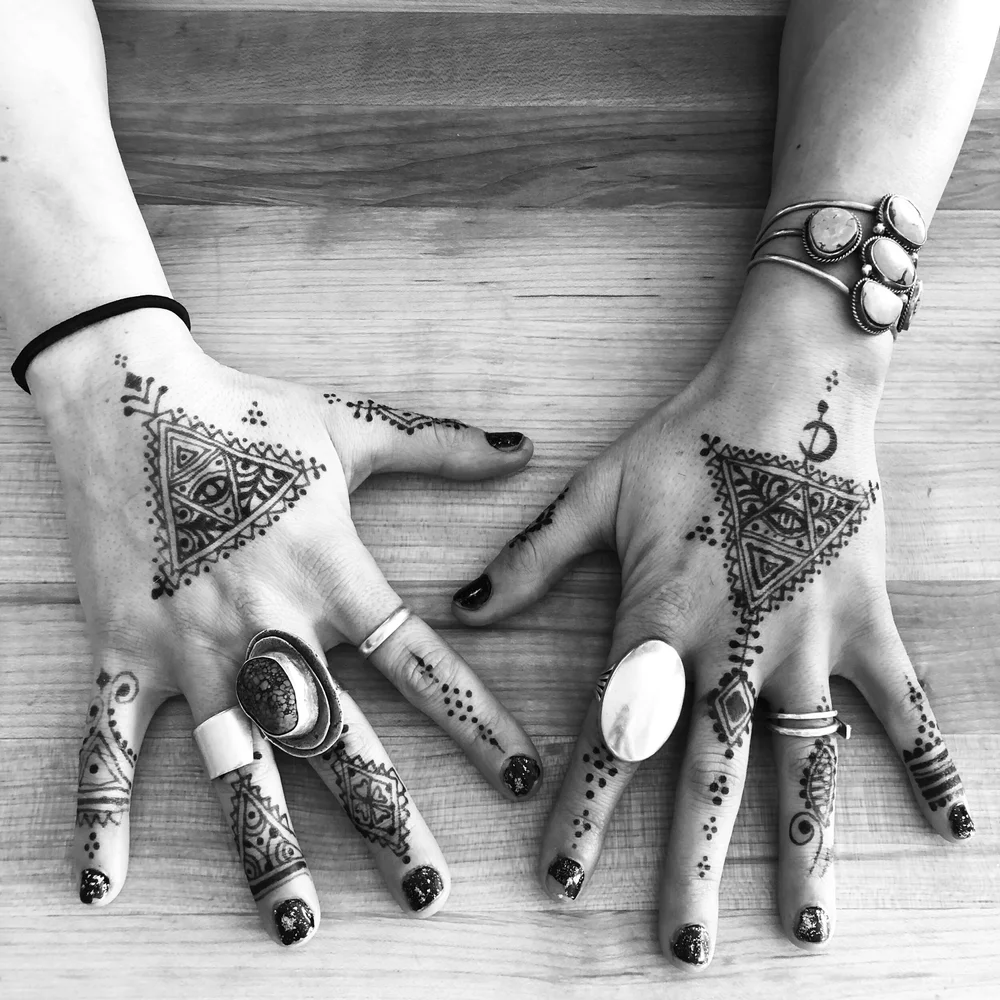
Photo by Peter Shin
What does henna have to do with astrology?
Surprisingly, a lot— in more ways than this author has time to realize, but today, we’ll keep it simple. This ancient form of adornment provides a connection to the zodiac via three words: this too shall pass.
These well-worn words can provide great comfort upon reading a difficult horoscope or when you find yourself in the middle of a rough transit. Mercury in Retrograde. Again?! This too shall pass. And yet, this simple mantra is perhaps most powerful when called on during good times. That’s the lesson I glean from freshly hennaed hands. Technically, jagua-ed hands—black ink from the jagua fruit—but that’s another story.
A few weeks ago, I spent a Saturday morning with my friend Monique Herzig at her Ferndale studio, Alchemy Slow Living, where she offers henna services and facials. It’s also the lab where she makes perfumes and other apothecary delights. I came to learn about the art of henna, the red paint leaf used across the globe: Morocco, India, Pakistan, Bangladesh, Tunisia, Afghanistan…
Monique’s own journey with henna started eight years ago as a way to spend more time with her children—"the real draw for me was being able to sit close and sit quietly with my kids.“ And then, she was hooked. The stories and the histories drew her in. "I love that it’s primarily the purview of women.” More than once in our conversation, she tells me that she created her studio as a place to be “soft and vulnerable.” A contrast to the rest of her life where she has to get things done, this is a place “to sit still and to sit quietly.”
Monique offers me an oat milk latte and a chair across a slim table from hers. The room is filled with light and smells of sage and apricot. She takes my hand and begins to draw, without consulting me. But she doesn’t have to. She knows just what my hands desire. It is the perfect moment atop a perfect morning.
After an hour of salon like therapy and insightful conversation, I return to the world with hands I can’t stop admiring! Lines, dots, flowers, lush plants, an eye that would later prompt a gas station clerk to ask, “Is that a Freemason thing?” And he isn’t wrong. The language of henna is universal.
“One of the interesting things about Henna is that if you look far enough back when we’re all using the same tools, the same images are there. No matter where you are in the world, it’s probably drawn with a finger and so the images are pretty similar. Some of the symbolism evolved, as our human communities evolved. Textiles emerged and decorating our spaces emerged. And those images developed a language and a meaning. It’s an evolving practice. And the symbolic origins of the henna has always been of protection. But like communities increasing in complication as they develop and evolve , the symbols got more complicated.“
Monique says her own attachment to henna is primal—"I can’t even articulate the way I feel attached and connected. The idea of having just stepped into a pool of henna paste and feeling it squish through my toes..”
I understand. There’s something uniquely relaxing in having someone take you by the hands and draw on you for an hour. While the ritual of henna has a rich and complex history, I set that aside for someone more knowledgeable to explain. My experience with left me with the simple joy of: This is beautiful. I want to look at it. I want others to look at it.
It’s the same reason I wear jewelry: I like the way it makes me feel. Unlike jewelry, my henna came with another thought: How long will this last?
Traditionally, Monique explains, henna was “done at times of transition…from girl to woman, from woman to wife, from wife to mother. In some cultures, once you are no longer married, either through divorce or death, you don’t do henna anymore. Because there’s no longer a transition for you.”
IT ALL PASSES
My henna didn’t mark any major transition, but it did get me thinking. How long would my henna last? A week? Two weeks? How long would I have with this cherished new position before it fades away? And my hands? How long before they curl up and turn to dust? Impermanent in its meaning and its visual aesthetic Yes, all these things shall pass. Even if I don’t want them to.
“The things that that cause us pain,” Monique reminds me, “are the things that we remain attached to. Henna is a way to remind ourselves that it’s okay to put a lot of time and effort and energy into beauty. Even if it’s fleeting—floral design, an exquisite meal. Anybody who invests that much energy into something, and then lets it go is learning an important lesson.”
Perhaps the biggest misconception with henna is that it’s impermanent. While the intricate designs fade, the molecule in the henna plant permanently binds to the molecules in your skin. What we perceive as the henna falling off is actually the outer layer of our skin sloughing off and disappearing, “to be brushed out into the wider world.”
All of which is a very long-winded way of saying: this too shall pass universally affects all things. Including ourselves.
With astrology, as with life, it’s easy to see ourselves as static objects getting bounced about by planets and circumstance—my relationship coming in from the right, Mercury’s approaching from the left...to feel that life is happening to us, at random.
The permanence of henna is a reminder that we are living, shape shifting miracles. Henna, like astrology, marks the events and our lives and the passage of time, but it is “we” who do the living. Yes, we too shall pass through this moment into this next—changed! Not by outside forces but by our own beautiful ability to grow and evolve as part of an ever-changing, interconnected environment.
That’s the lesson I learned from henna. And when I did, the anxiety that followed the joy of looking at my hands was replaced with meaning and gratitude. This work of art will fade away to reveal a literal new me. I can choose to either fear this experience or celebrate it.
With celebrating it comes the gift of knowing I get to do it again: fresh hands for fresh henna. I too shall pass through this experience and into the next again and again and again.
Interested in astrology? Join ART of the ZODIAC for Lunar Salon & Apothecary, a monthly check-in with the astrological weather. Next month’s salon takes place on Sunday, March 15th, at the Schvitz.
In October, Monique is headed back to Morocco as part of an immersive henna experience in a henna homeland- MEKTOUB: A Marrakech Henna Journey October 9-14, 2020. Curious? Contact Monique via moherzig@gmail.com for more information.
FOLLOW ON IG:
LIKE ON FB:
Written in the Stars: The Astrological Lessons of Henna published first on Source

No comments:
Post a Comment